Do I need a written contract to sell a car?
No, the law prescribes no particular form; a contract for a car is valid even if it is only agreed orally. A written contract is still strongly recommended. Only a signed sheet can later prove what mileage applied, what was promised and whether the warranty was excluded.
A contract only needs a particular form where the law prescribes one (Art. 11 of the Swiss Code of Obligations, CO). For buying a car, it doesn’t. But disputes only arise after the handover, and then what counts is what is on paper.
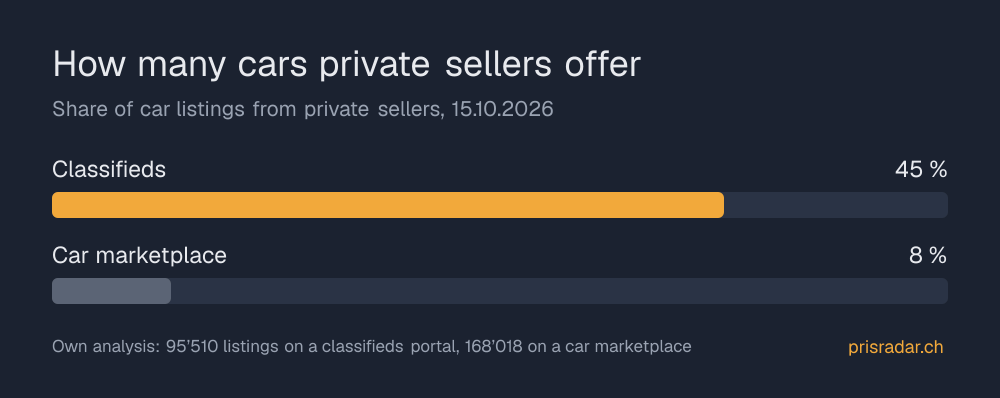
The contract is most often needed between private individuals. On a large classifieds portal, 43’166 of 95’510 car listings come from private individuals, that is 45 per cent. On a large car marketplace it is 8 per cent (our analysis of 15.10.2026).
If you buy from a dealer, the dealer’s contract applies. Check the same points there as below. What else to bear in mind when selling a car privately in Switzerland is covered in a separate guide.
What goes into a car sales contract?
The names and addresses of both parties, the car with its matriculation number and chassis number, the mileage as read, the price and the payment method. Plus the date, time and place of handover, the documents handed over, known damage and the agreement on warranty. At the end, both parties sign.
| Detail | Where to find it | Why it matters |
|---|---|---|
| Matriculation number (Stammnummer) | Vehicle registration document | Identifies the car uniquely in Switzerland |
| Chassis number | Vehicle registration document and the car | Must match the car in front of you |
| Mileage | Odometer at handover | Records the condition on the day of handover |
| Time of handover | Entered by you | From then on, the buyer bears the risk for the car |
| Documents handed over | Registration document, service book, inspection report | Proves what was handed over |
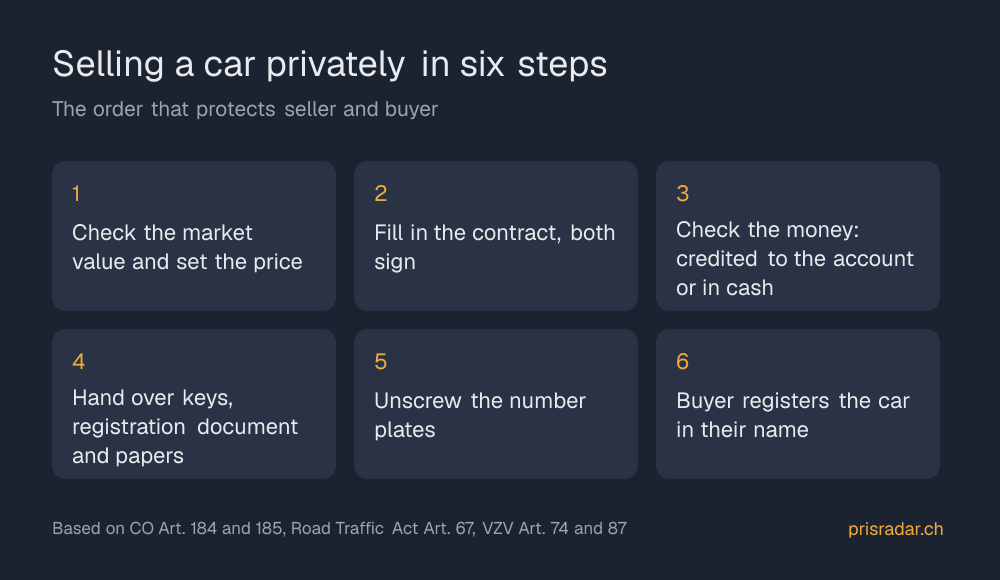
The time matters more than it looks. Unless agreed otherwise, benefit and risk pass to the buyer as soon as the contract is concluded (Art. 185 CO). So if you sign on Monday and hand over on Saturday, you record that the risk only passes on handover. The template below does that.
The best way to set the price is after a look at the current market value of your car.
Where can I find a template for a car sales contract?
Right here on this page. You fill in the template directly in your browser; nothing is saved or sent to us. “Print template” puts only the form on paper or into a PDF. Print two copies, both parties sign both, and each keeps one.
Sales contract for a motor vehicle
Seller
Buyer
Vehicle
Handed over with the car:
Price and payment
Handover
Benefit and risk pass to the buyer at the handover. The vehicle registration document and the keys are handed over once the full purchase price is paid. The number plates stay with the seller. The buyer registers the vehicle at their own cost.
Page 1 of 2
Sales contract for a motor vehicle
Condition and warranty
Seller’s signature
Buyer’s signature
Template by prisradar.ch, as of 15.10.2026, without warranty and without legal advice. Print two copies, both parties sign both, each keeps one.
Page 2 of 2
By law, payment and delivery happen at the same time: money for car, both in the same moment (Art. 184 para. 2 CO). The template therefore states that the registration document and keys are only handed over against the full purchase price. It is a sample without guarantee. For company cars, export or a running lease, it is worth having a professional take a look.
What does “accident-free” mean in a sales contract?
If you write “accident-free” into the contract, you warrant a quality. The seller is liable for warranted qualities, even for defects they did not know about. So only write what you know. “The seller is not aware of any accident damage” is more honest and protects you better.
That is what Art. 197 of the Swiss Code of Obligations says: the seller is liable for warranted qualities and for defects, even if they were unaware of them. If the seller warranted the absence of a defect, they are even liable for defects the buyer could have seen for themselves (Art. 200 para. 2 CO).
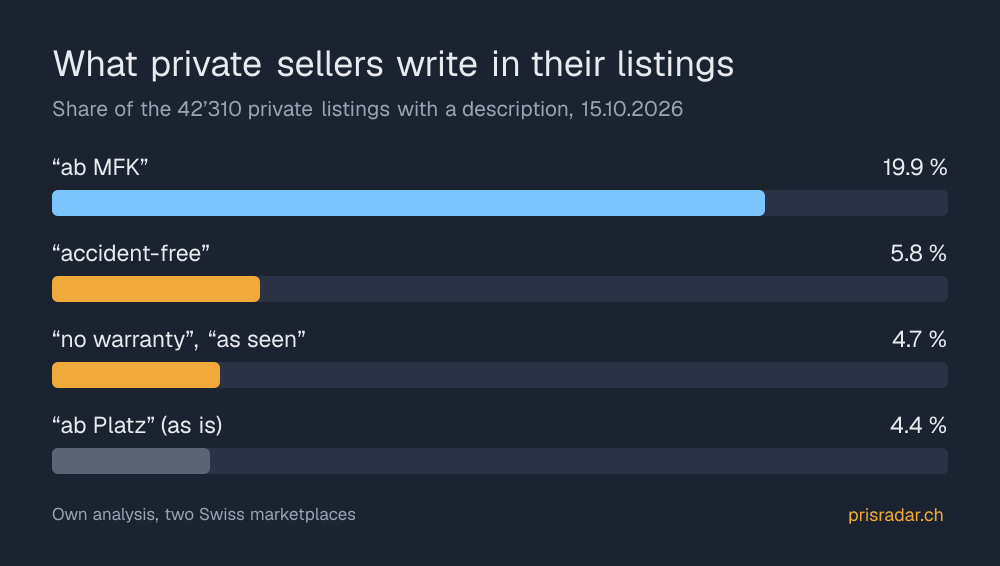
In 2’455 of 42’310 private listings with a description on two large Swiss marketplaces, the word “unfallfrei” (accident-free) appears, that is 5.8 per cent (as of 15.10.2026). What the listing says should not read differently in the contract. Where the line between a minor scrape and an accident lies is explained in the guide on when a car counts as accident-damaged.
How do I exclude warranty as a private seller?
With a clear sentence in the contract, such as: “The car is sold as inspected and test-driven, excluding any warranty.” The law permits this exclusion. But it does not apply if the seller fraudulently concealed a defect. Known damage therefore belongs explicitly in the contract.
Art. 199 CO draws the line. Without an exclusion, the seller is liable for two years from handover (Art. 210 CO). Dealers who sell a used car to a private individual may not shorten this period to less than one year.
Many sellers already put the exclusion in the listing. 2’006 private listings contain phrases such as “ohne Garantie” (no warranty) or “wie besichtigt” (as inspected), 1’841 the expression “ab Platz” (as seen, collected from the seller) (as of 15.10.2026). But the exclusion is only secure once it is in the signed contract. As a buyer, inspect the car immediately after handover and report any defect at once, otherwise the car is deemed accepted (Art. 201 CO). What to look out for is covered in the guide Buying a used car: what to look out for.
How do I protect myself when I get paid for my car?
Only hand over the car, keys and vehicle registration document once the full price is there. That means cash in hand or credited to your account, not a screenshot of a transfer. Large amounts of cash are best counted together at the bank counter. If someone asks for your card details to send you money, it is fraud.
The Federal Office for Cybersecurity warns of phishing on classified ads. A supposed buyer sends a link or a QR code through which you are meant to “confirm” the payment. To receive money, you never have to enter credit card details or confirm a code. Screenshots, PDFs and e-mails are not confirmation; only the money arriving in your account counts.
As a buyer, the reverse applies: no advance payment for a car you haven’t seen. Swiss Crime Prevention describes vehicle advance-fee fraud, in which a supposed transport company demands an advance for a car that does not exist. And don’t send copies of personal documents to strangers.
What happens to the number plates, registration document and insurance?
The number plates stay with you; the vehicle registration document goes to the buyer. Unscrew the plates before the handover. The buyer registers the car in their name with the old registration document and their own insurance. That ends your existing insurance contract for this car.
The plate number stays reserved for you as the keeper (Art. 87 of the Road Traffic Licensing Ordinance, VZV). For the change of keeper, the buyer needs the old vehicle registration document (Art. 74 VZV). Rights and obligations under the insurance contract pass to the new keeper on a change of keeper. If they register the car with a different insurer, the old contract ends (Art. 67 of the Road Traffic Act).
If no new car follows, you return the plates or deposit them. Deposited plates suspend the insurance (Art. 68 para. 3 Road Traffic Act). In the canton of Zürich, depositing them for a year costs 50 francs, destroying them nothing. Fees differ from canton to canton.
What applies when selling a leased car?
A leased car belongs to the leasing company, not to you. If the vehicle registration document carries code 178 “change of keeper prohibited”, the road traffic office will not issue a registration document to the buyer without the leasing company’s consent. So before the contract, agree with it how the outstanding amount will be paid off.
The basis is Art. 81 para. 2 of the Road Traffic Licensing Ordinance: the authority refuses to issue the document to a new keeper as long as the entry exists. Only the person or company named in the form can release it, as the Zürich road traffic office on code 178 explains.
As a buyer, therefore, look at the vehicle registration document before you pay. What a running lease costs each month is shown by the leasing calculator with interest check. How a lease’s residual value differs from market value is explained in the guide Calculating a car’s residual value. Whether selling to a garage is easier is shown by the comparison of a garage and a private sale.